
AI writing assistant updates 2026 quickly become outdated, as it’s the nature of the tools. I’m continuously writing and adding to the list, so this is more up to date than creating a list of the changes by the end of the year, because I actually see these changes in my own workflow.
This is not a “straight dump” changelog. The nitty-gritty of how I use these tools on a day-to-day basis was changed because of updates those that aren’t insignificant UI tweaks that no one should know about, but in fact are helpful.
In this article, I’m addressing the three tools that most content creators use: ChatGPT, Claude, and Jasper. Regardless of which combination you use, the pattern of that: updates based on the underlying pattern applies here, too.
Why These Updates Happened So Fast in 2026
AI services competition between OpenAI and Anthropic intensified this year notably, which is reflected in how they’ve each been releasing services. This is in part why it isn’t helpful to be adhering to a year-end list in February.Besides, multiple model releases hit both companies within a matter of months, making that list stationary after February.
For creators, the outcome is a change to the default model under which you currently work, whether you’re using a particular tool or not, probably at least once or twice a year and often concealed in the product without much fanfare.

ChatGPT: What’s New in 2026
OpenAI has continued to deliver a rapid pace of shipments this year. What the real changes mean for content makers:
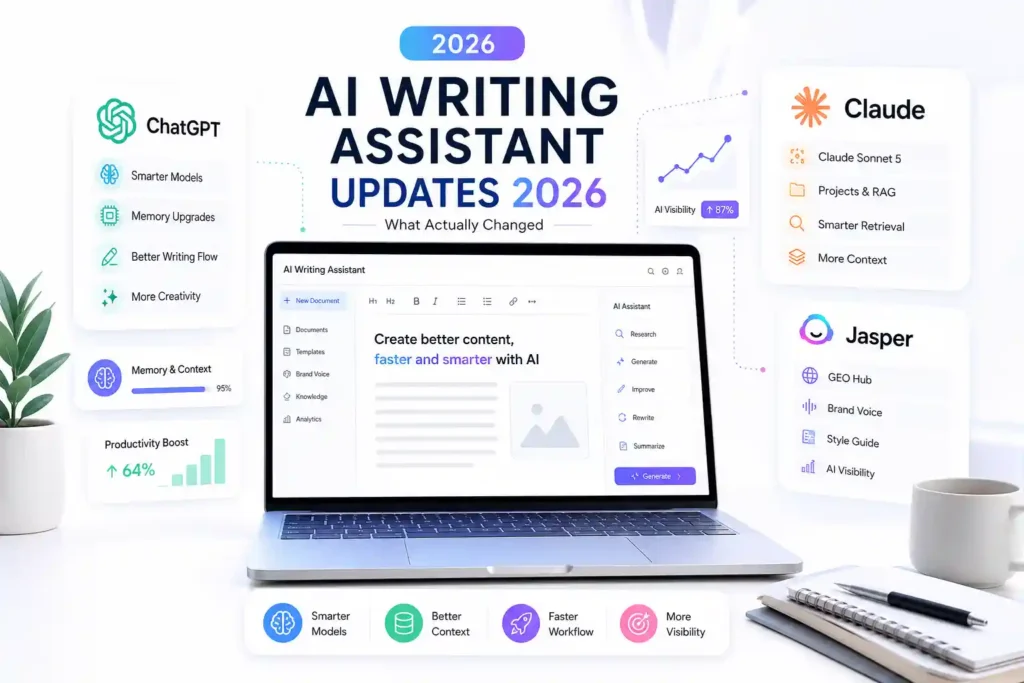
In 2026, ChatGPT continued to receive major improvements in models, memory, and personalization, helping creators follow better instructions and keep their workflows consistent.

Persistent memory now keeps track of the facts about you across all conversations, even incredibly niche conversations, your tone, ongoing projects, without having to re-explain them all the time. Official source
The writing methodology of ChatGPT has continuously evolved, where memory, model improvement, and internal creative capabilities are becoming increasingly important for content creators.
Generating images and text to speech is now conveniently integrated into the same chat interface without requiring an app.
If you’re a blogger or content creator, the two changes you need to make are memory and Canvas. All of the information that was stored on the previous sessions are now carried over automatically, and now how much setup an individual chat actually requires.
Custom instructions have also grown larger, giving creators more room to choose their preferred writing style, tone, and workflow.
resources: OpenAI ChatGPT Release Notes
Claude: What’s New in 2026
This year, the focus of Anthropic’s modifications has been more on the level of capabilities rather than dazzling features.
As of July 1, 2026, the Free and Pro versions of Claude Sonnet will switch to use Claude Sonnet 5 as the default model, replacing Claude Sonnet 4.6. Official source
Cloud Sonnet 5 has transformed in a major 2026 model update, while Cloud Projects also improved how uploaded information is retrieved, making large reference libraries more useful for writers.
The smarter retrieval now works at Claude Projects, as only the parts of your uploaded documents in context are retrieved, freeing up valuable disk space for larger reference libraries to be generated.
Many of the features introduced in the newer plans and bundles for Fluent are present in Claude, too.
This is particularly useful for content creators to store brand guidelines, style guides, research documents, and previous content without having to repeatedly replicate the same context. Anthropic Newsroom

Jasper: What’s New in 2026
While a new writing feature is an easier-to-implement change, Jasper’s primary change is moving it from a feature to a focus. Official source

- June 2026 sees GEO Hub launch where it monitors a brand’s presence in answers generated from ChatGPT-like AI response channels, rather than Google, prioritizing the optimization of AI, not search.
- Brand Voice continues to be the key factor, which is then established and applied throughout bulk content over the same branding voice.
- Jasper’s GEO Hub is one of its biggest 2026 developments, helping brands see how they appear in AI-generated responses and identify opportunities to improve AI visibility.
What These Updates Actually Mean for Content Creators
Taking away the feature names reveals the pattern in all three of these tools, this year:
Memory and context grew up/more repeating yourself, less hands-on; more of your context is carried forward automatically.
The relevance of AI “visibility”, which will be referenced within AI generated responses, is on par with classic search engines.
Evolution of general vs specialized writing tools more and more towards narrowing difference between GPA and specialized writing tool

For a direct, tested comparison of how these two handle real writing tasks, see our full Claude vs ChatGPT for writing breakdown.
Quick Comparison | 2026 Updates at a Glance
| Tool | Biggest 2026 Change | Why It Matters |
| ChatGPT | Persistent memory + Canvas | Less repeated context, better long-document editing |
| Claude | Sonnet 5 default, smarter Projects retrieval | Larger reference libraries now usable without hitting limits |
| Jasper | GEO Hub for AI-answer visibility | Tracks brand presence inside ChatGPT, Claude, and Gemini answers |
How Often Should You Check for AI Writing Assistant Updates 2026?
Unless you are a die-hard, weekly DMPs are not needed by most creators realistically. There may be incremental updates between the checks, but it’s just about enough if you take a look of the tool’s changelog or blog once per month to see anything that could really change your workflow.
The exception is if a default model changes such as from Sonnet 4.6 to Sonnet 5, which can result in different out, different tone you don’t need to do anything. These should be ones you notice right away because your current Custom Instructions and prompts may require a quick re-check after.

Final Thoughts
So far in 2026, the focus of every AI writing assistant update hasn’t been on fancier writing, but rather on better context management and increasing attention to the visible aspects of AI-generated responses, not just traditional search results.
I’ll keep updating this when the tools bring meaningful changes, not minor tweaks. If you’ve seen any update here that has changed your own workflow, let me know in the comments this is usually how the next version of this list gets put together.
Frequently Asked Questions
Which will be the most significant growing enhancement to AI writing instruments in 2026?
The biggest AI writing assistant improvement for most content creators in 2026 will be enhanced memory & context handling, with ChatGPT's current memory and Claude's better Projects retrieval providing less time to re-explain your context each session.
Does prompt changing after these updates need to be considered?
Typically, not for small releases. If a default model update occurs, such as the introduction of a new version of Claude or GPT, it is advisable to test the prompts with the new version to see if there are any changes that affect their outputs. The outputs may also vary as the default model changes; even if the prompt remains the same, the output tone and quality might be slightly different.
Is Jasper still worth it after these updates?
Well, it relies on the case in which you use it. Claude or ChatGPT is $20/month and still suits most of the purposes for a solo creator. So while Jasper's 2026 direction and brand consistency, AI-visibility tracking are geared more towards teams and agencies that want to handle multiple brands than towards individual writers.




Great overview of the latest AI writing assistant updates for 2026! The comparison between ChatGPT, Claude, and Jasper is clear and practical. I especially liked the focus on how these updates actually impact content creators instead of just listing features. Looking forward to more insightful articles like this!
Excellent article! The section comparing ChatGPT’s memory, Claude’s smarter Projects, and Jasper’s GEO Hub made it much easier to understand which tool fits different needs. Thanks for keeping this guide updated with meaningful changes.
nice information