

A year ago, using and experimenting with generative AI technology to create content was still a novelty for people at the weekends. Now it’s why a single blogger can go out of content in a single afternoon and publish, design, and promote a week worth of it.
Here’s all you need to know, including exactly what generative AI is, how it supports web content specifically, what various kinds are available, and a step-by-step guide to start utilizing this tool without losing a lot of your voice.
For perspective, reach out to your content professionals in 2026, and more than 65% report using AI every day – and that doesn’t indicate an increase in junk production! They’re creating the work as they might hope, quicker, since the repetitive elements were outsourced.
We shall continue to be practical. Lacking jargon and unnecessary hype | it’s what works for real 2026 content creators.
What Is Generative AI for Content Creation?
Generative AI for content creation refers to content Generation” denotes AI Models that generate original content, text, images, video, or audio from a prompt or instruction you provide the AI Model. You don’t need to look up existing text or outsource it to someone to create it from a new source, just describe what you need and the model does it.

The models used for this are known as Large Language Models for text, Diffusion Models for images, and increasingly complex systems for video and audio support. These models are trained on large datasets including text (Large Language Models), images (Diffusion Models), and, increasingly, videos and audio (expandable video/audio models). That training enables them to make sense-out-of-nonsense blog posts or a photo-realistic image or a natural-sounding voiceover simply from a prompt.
One key thing to keep in mind: It is not “templated content”. A set of patterns that are used to create a document. In fact, when using Generative AI, it generates something new every time based on your input.
A very basic scenario: Request a template tool for a product description, and it will fill the template with details in a hardcoded format. Try the same with Claude and ChatGPT and get a new copy every time – adjusting tone, length, angle of your query, etc..
How Generative AI for Content Creation Actually Works
The basic workflow is, you give a prompt to the model describing what you want it to output. This model is used to predict one character (or one pixel) at a time based on the patterns that it learned during the training process. Hardly database copying, rather it’s generating new output according to probability.

You determine the tone and context of a prompt, and offer instructions
The model yields a first draft based on these inputs
You see, modify and polish the result
The final version is AI generated and verified by human eyes.
The final step is more important than most guides would like to acknowledge. This is not the product of AI, it is its beginning. In the minds of the creators who are having the best success, it’s treated that way.
The Different Types of Generative AI for Content Creation
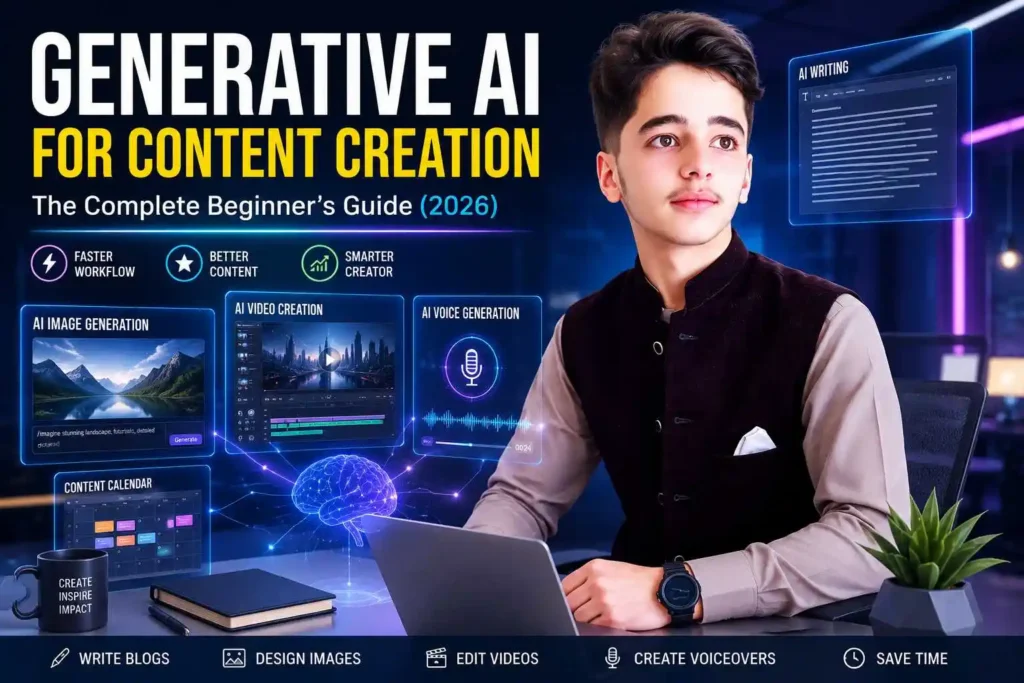
Most people think of ChatGPT when they hear this term, but text is only one piece. Here’s the full picture of Different Types of Generative AI for Content Creation
Text Generation
Blog posts, captions, email newsletters, scripts. ChatGPT and Claude are able to do this effectively and shorten the time that you may spend writing a blank page that requires editing. An hour that was traditionally required to write an article from scratch can now be reduced to 15 minutes, allowing you to spend the remaining to research and add your own point.


Image Generation
Original graphic images based on the written words of a text description. The simplest choices were Midjourney and Canva AI, which can help you create website feature images, share images for social media posts, and generate brand images even if you don’t have a stock photography subscription. This is especially important for creators who do not have any design skills or budget for a designer.
Video Generation
B-roll generator programs such as Runway and Descript provide tools beyond narration to help creators create B-roll, slice a long video into clips, or even edit by editing a text transcription. The least developed, yet most rapidly developing. Any single long-form video can now be shortened to multiple short snippets, in less than an hour.


Audio Generation
When creating a podcast or a narration, some people don’t want to record each line, that’s why you need voice cloning and text-to-speech software such as Eleven Labs to render natural-sounding narration and voiceovers. Others have taken advantage of this feature to produce content that can be voiced in multiple languages, eliminating the need for a different voice actor in each.
Benefits of Using Generative AI for Content Creation
This recent leap in the adoption of generative AI in content marketing is much more than a buzzword; it’s a tool with some clear, tangible benefits:
• Speed | first sketches which used to take hours can be made in minutes
It’s now possible for one creator to generate what previously needed a small team of creators, via the power of ‘Volume’.
Consistency – the tools like Claude will have a more consistent tone from longer documents than a worn out writer at 11pm.
So, it has accessibility features which means that anyone can create graphics, non-designers can produce video content.
Cost | there are many good free tiers available for the majority of the initial tools, which helps decrease the barrier for a new creator
This, in no way, takes the place of strategy or judgment. It bridges the gap between the idea and a draft.

Generative AI vs Traditional Content Creation: What’s Actually Different
Specificity is crucial when dealing with changes and staying true to what does not change.
Speed: A first draft that was an afternoon, now takes minutes editing time does NOT go away, it’s just pushed further on in the process.
For an initial pass, design and video editing skills are less relevant, while for more a judgmental skill as an editor is more relevant because now you are curating and refining instead of creating from scratch.
For “traditional” content: People targeted = cost. Creating with AI scales with you and a small subscription fee
There’s consistency: By the end of the night, a tired human author has become bad. However, AI-generated content remains the same, either good or bad | That’s why human oversight is still crucial.
Genuine concluded: generative AI for content creation eliminates the blank page and the initial 80 percent of grunt work. It is not a replacement for a person who understands what good content should be!.
How to Get Started With Generative AI for Content Creation

If this is your first time, do not change all your workflows as you tackle everything simultaneously. This is a sensible order:
Gradually start using these tools by selecting only one that you need to use more for (writing, design, or editing).
Using it on actual work, not test projects, for 2 weeks every day, Step 2.
Use the same process to create a basic prompt template for your most recurring assignment (such as a blog outline or a caption).
Step 4: Adding a second tool after the first one is a true habit!
Follow AI-generated content with your voice changes in your content in Step 5.Step 5 | Always edit AI outputs for your voice before publishing
Best Practices When Using Generative AI for Content Creation

• Be sure to verify the accuracy of facts produced by AI before sharing them | AI can be very conclusive in incorrect statements
Be sure to feed the model context such as brand voice|not just a plain topic.
As with editing for creativity, the clear sign that the writing is unedited is the lack of detail and specificity.Unedited AI content is easily identifiable by the general or commonplace nature of the text.
Think of using AI for draft and structure, the last 20% should be completed using your own voice.
If your product uses AI, you must indicate it, just as you do with certain images.If the product is using AI, you must tell the users, much like you would for certain images.
Common Mistakes to Avoid with Generative AI for Content Creation

But there are a couple of patterns which emerge continually as new creators start out:
Microblogging, or publishing AI content as it is, is noticed by both readers and search engines. When there’s no editing of AI-created content, both readers and search engines detect that.
Expecting precision when only wordy questions are asked | wordiness to obtain wordiness
Tackling 5 tools at once rather than learning one
Or bypassing the platform’s disclosure rules regarding AI-generated or AI-assisted content.Or failing to comply with the platform’s rules regarding disclosure of AI-generated or AI-assisted content.
Each and every one of them can be remedied with a slightly aggressive and slow approach..
The Future of Generative AI for Content Creation
The tools are in constant use and developing quickly. The ability to generate text, images and video from a multimodal interface is now commonplace and not an exception. Tight integration with current platforms like WordPress, Canva and social schedulers is anticipated, as will enhanced fact checking and citation capabilities to address concerns about accuracy, as AI companies react.

There are also some changes on what search engines and platforms give for. Content by AI, devoid of authentic personal experiences and original research, is being lost in visibility; content that combines AI-generated writing with the human touch of personal experience and original research is doing well. The tide probably won’t turn back in the opposite direction.
This is unlikely to change: those who embrace AI combined with their own personal experience will continue to generate more Authentic, Real-world content than AIO or traditional, manual approaches.
Frequently Asked Questions
What is generative AI for content creation?
Generative AI for content creation is Generative AI for content creation refers to the use of an AI model to generate a piece of content, such as text, image, video, or audio, from a prompt. Instead of coming up with or creating content, you specify the content and the AI will draft it for you.
Is generative AI content safe to publish?
Yes, but it doesn’t have to be polished and ready for publication. Check the facts for accuracy, edit for voice and add real experience/exemplifying before publishing. Whether content was created on the cheap or with great care, search engines will favour it if it’s helpful and accurate..
Which generative AI tool should I start with?
For tasks that take the longest, start by performing the one that you can do easily. Claude or ChatGPT should be used first by writers. Canva AI is the recommended platform for designers to begin with. The best software for video creators to use is Descript. Learn one tool every 2 weeks until mastered.
Will generative AI replace content creators?
No. Changing the job – not taking it away. Meetings are becoming more of a collaborative, creative process with repetitive content tasks increasingly being automated, allowing creators to concentrate on strategic planning, original creation, and audience engagement aspects of content production that AI cannot yet match..
How is generative AI for content creation different from regular automation?
Regular automata are automata that output the same when they get the same input. AI that creates content by generating is context and phrasing dependent. That flexibility is exactly why it’s particularly useful for creating, and also why prior to going live you should (and must!) have human review rare.
Final Thoughts
Getting good at generative AI for content creation isn’t About getting on to the latest new tools when they are released. You’re just selecting one or two that addresses a legitimate problem in your workflow and sticking to it and making sure you are in control throughout.
Start small. Evaluate this rule by picking one of the tasks that are taking the most time and giving it one honest week to see how well that works before you decide the next step.
What is the first thing you think to give to AI when developing content? Please tell in the comment section.
Also Discover Best AI Productivity Tools 2026 or go back to home page


Excellent article! I like how you explained generative AI beyond just writing and covered text, images, video, and audio in one practical guide. The emphasis on editing AI-generated content with a human touch is especially valuable. Thanks for sharing such an informative resource!