
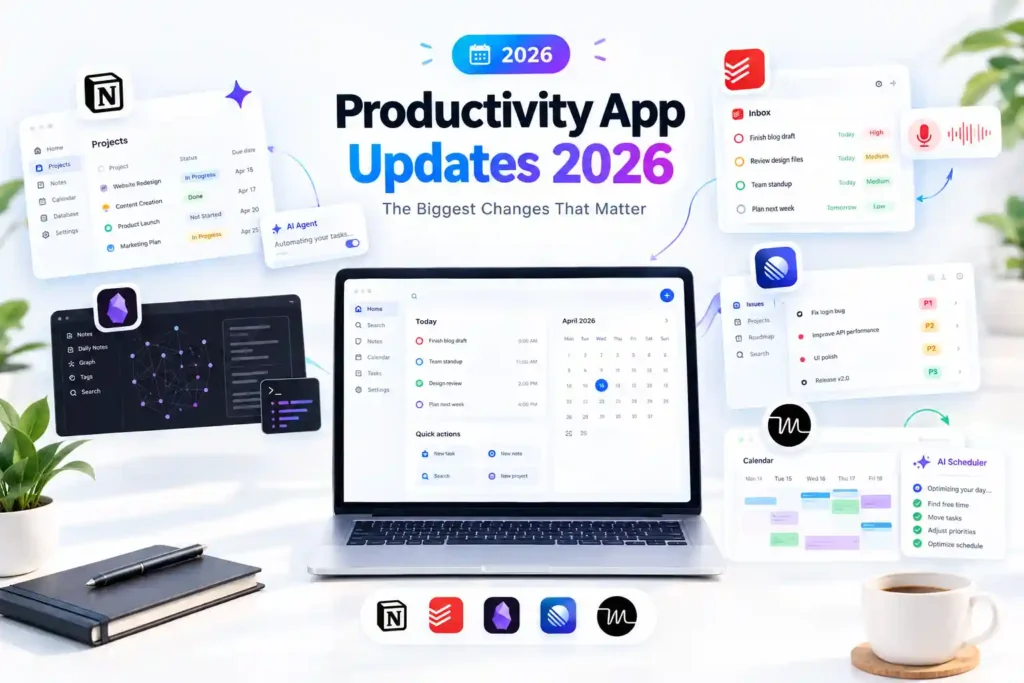

Major changes are the only ones included in most of the reports of productivity app updates 2026. Here this is the one without the noise.
They are tools I use everyday and follow. The updates below were those that affected the way a task, a note or a calendar is handled, rather than a change in UI color, which was not discussed nor requested.
Five Apps Five Real changes. These are what’s going on the ships and why it is worth watching.
How This Year Compares to 2025
Most of the discussion was about the incorporation of a chat panel into a tool, a place where people can ask questions about their notes, or get a first draft. Helpful but tacked on.
The menu of productivity app updates 2026 seems more of a built-out. It is not just about using AI on the surface of the app anymore; it’s about using AI as a feature that operates in the background of the app.

Notion: Autonomous Agents
Notion’s Custom Agents can now automate recurring work in the background, using your workspace data, triggers, and schedules to take actions without you manually starting each task.

Workers go further. Notion also introduced Workers, a developer-focused way to run custom code on Notion’s infrastructure and connect external systems, databases, and agent workflows.
Which is thought to be more like programmable infrastructure than as an extension to a chatbot.
Create one that will generate the numbers, format the page, and save it in a status report that you create each week on Friday, before you have a cup of coffee.
They can also schedule recurring tasks for agents to perform in their own schedules.
Works with your actual database, not simply the pro-forma you’ve been handed (but it can be stored in it, too!)
Even setting up is still a bit of a trial and error process for trigger help
Notion’s agents work off saved context too. If you use ChatGPT alongside Notion, this setup closes a similar gap.
Todoist: Voice-to-Task
Todoist launched Ramble. Talk normally and convert the loitering into appropriate endeavors.
Smart views were placed on top as well, discovering what you are doing rather than applying manual filters.
A car trip note segment from talking through a jumble of errands/follow up items, followed by a note that arrives later and is separated out into usable, labelled tasks, is what makes these occur everyday throughout the week.
- Ideal for work on the go (such as while walking or driving, to capture tasks).
- Be aware that longer voice notes with multiple topics will take nuances away, reducing the accuracy of your response.
- It takes some weeks of the use of smart views before suggestions seem to be correct.

Obsidian: A Real Command Line
Obsidian officially introduced its CLI in February 2026, giving users a command-line interface for scripting, automation, and external integrations.

The answer was always there, in the form of plugins, and now it is available.I’ve always been able to do scripting or automation, and that’s now an option. A true command-line interface unlocks tools completely outside of Obsidian, backup scripts, batch processing and custom workflows.
If you are a writer with years of notes stored in one vault, this opens the door to saving them, searching them or reformatting them in one fell swoop rather than having to click through each one.
The terminal option is only very useful for the technical users who are used to it.
With non-technical users, there will be no noticeable differences from one day to the next.
Linear: Sub-Issue Automation
In 2026, Linear’s bigger story has been its move toward AI-assisted project and engineering workflows.
- Linear introduced Linear Agent in March 2026, allowing teams to use AI to investigate issues, create reusable skills, and automate parts of their workflow.
- By June, Linear added coding sessions that let its agent work with Claude Code and Codex, inspect project context, write code, and return changes for review.
- For engineering teams, this is a much more meaningful 2026 change than sub-issue automation because the AI is becoming part of the actual development workflow rather than simply helping inside a chat panel.

Why the Update Pace Picked Up in 2026
These are not single feature drops. By 2025 and 2026, this competition amongst productivity tools increased, as also did each of the product’s race to integrate AI into the product, rather than adding it on as a side panel.
To anyone who already has these tools it is good news because they will play with more competition. Features that once took years to become mainstream are now reaching productivity apps within months as competitors race to integrate AI directly into their core workflows.
It isn’t without a price either. It requires effort to stay current with every change communicated in 5 or 6 tools and that is why it’s much better to review the updates every month than one-by-one ‘on the fly’.
Motion: Still the AI Calendar Specialist
Motion continues to focus heavily on AI-powered scheduling, automatically planning tasks around deadlines, priorities, availability, and calendar commitments.

- It is most clearly visible for those with multiple calendars, a free-lancer who has to deal with clients’ calendars and their own calendar, or a person hosting two businesses at the same time.
- Recommend this for individuals who may have several job calendars and or businesses.
- Generally, it required more manual scheduling than most task applications and required a higher fee.
The Pattern Behind All of This
All of the updates that followed allude to the same direction: From chat to the native data structure of the app.
Notion is not just a conversation-run program; it’s a Workers program. Todoist’s smart views learn from what people do, rather than what they type.
The broader direction is clear: productivity software is moving from AI as a chat-based assistant toward AI that can work directly with the application’s underlying data, workflows, and actions.
It has not yet been made possible to connect any of these offers to each other. A real ‘work flow’ that crosses from email to a project board to a calendar, still involves four or five apps – and no single update in 2026 will ever bridge that divide.

It is probable that next year’s real story will come out of that gap, cross-app orchestration as opposed to another single-app AI feature.
Quick Comparison
| App | 2026 Update | Best For |
|---|---|---|
| Notion | Custom Agents + Workers | All-in-one knowledge work |
| Todoist | Ramble voice-to-task | Simple daily task capture |
| Obsidian | Official CLI | Technical users, scripting |
| Linear | Sub-issue automation | Engineering teams |
| Motion | AI calendar scheduling | Calendar-first planning |
Should You Switch Tools Because of This?
An update isn’t a reason to try out a new application or tool, it’s a reason to experiment with a new feature for an application you’re already using.
Realizing life change is a task, moving years of notes, re-building structures of tasks, re-learning habits – switching costs in real time. This price often isn’t worth paying for a single good thing shipped by a competitor.
If you know you’ll need to repeat a similar task, give Custom Agents a try, starting with one repetitive task.
Do those things already on the Todoist first, then make a judgement after a week of testing out Ramble.

If you haven’t used these yet, chances are they are already on your radar and will likely be the ones you choose: всех these are oriented at the actual workflow they match, and for that reason, you will naturally gravitate toward one that is right for you, depending on your job shape and documents/databases (Notion), all tasks (Todoist).
Operating a juggling act with multiple calendars: Go with it, it’s worth the extra cost.
Final Thoughts
The key to the theme this year isn’t fancy dashboards. This is AI slinking out of the chat box and into the actions of the apps.This is AI seeping out of the chat box and into the action of the apps.
However that is not easy to see if you’re just reading the buttons and colors that were added in the next release. The real story is below & in what the app is able to do which you don’t have to click through per step.
Which one of the updates affected your workflow? Let me know.
FAQ
What's the biggest productivity app update in 2026?
The most prominent are Notion's Custom Agents and Workers. Where a chat assistant is content about your data, they can actually use artificial intelligence to act on your data—that's a very different thing.
Is it necessary to install different applications to avail such features?
No. Most of the updates gain on an automatic basis once you are subscribed to the plan. Before deciding that an app doesn't have a feature or is paywalled, make sure to look through the settings or the changes made since the last update.
How many times is it necessary to check for updates?
Most people only need to check the App's blog once a month. Unless your job requires the latest toys, once weekly checks are too frequent.
Do free plans come with these changes?
This varies based on the application and functionality. Notion's Workers and Todoist's Ramble feature both gone with limits on both the free plans.Both Notion's Workers and Todoist's Ramble are available in a limited fashion on its free plans with fuller features requiring a paid plan. Refer to the pricing page of the respective app for the updates.


Pingback: Free Content Calendar Template Google Sheets (2026) - creatafy
Really useful stuff! I didn’t realize so many AI features come with regular updates and that some are already available on free plans. Definitely worth checking the app updates before assuming a feature isn’t available.