
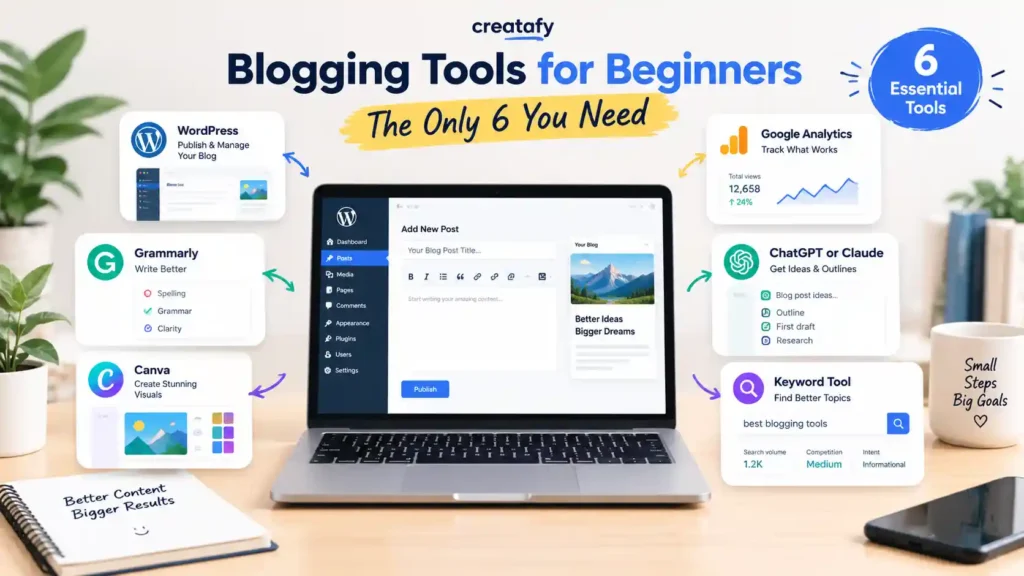

Most blogging tools for beginners list way too many apps. You don’t need twenty tools to start a blog. You need a small set that helps you publish, write, design, measure your traffic, brainstorm ideas, and research keywords.
Quick List
| Tool | Job | Free Plan? |
| WordPress | Manage your blog | Yes |
| Grammarly | Catching typos and awkward phrasing | Yes |
| Canva | Featured images and graphics | Yes |
| Google Analytics | Seeing who’s actually reading | Yes |
| ChatGPT or Claude | Outlines and first drafts | Yes |
| Ubersuggest or Google Keyword Planner | Basic keyword research | Yes (limited) |
The Only 6 Tools You Need to Start
1. WordPress
Stays the course for a reason. It’s where you publish and manage your content. Your content on social media is only as permanent as your relationship with the platform.
When you’re starting out, the default WordPress editor is usually enough. You don’t need a page builder for every post.
Your blog will load faster with a light-weight theme and wow-factor can be added with quality content.


2. Grammarly
Spots mistakes that your brain is too tired to find at 11 pm. The free version is enough for basic spelling, grammar, and clarity checks when you’re starting out.
It works inside Google Docs and other text fields, so you can catch common mistakes while you’re writing.
You don’t need to upgrade immediately. Start with the free version and only consider a paid plan if you eventually need its extra writing features.
3. Canva
No graphic design or Photoshop skills required. You can create a featured image for every post.
The free plan gives you plenty of fonts, templates, design elements, and basic tools to create images when you’re starting out.
Save a template and it’ll be available to use for all your future posts. This ensures uniformity across all your posts.


4. Google Analytics
It’s free to use and gives you a useful picture of which posts are getting traffic before you spend time creating more content.
Check it at most once a month for the first few months, or you will get anxious about unimportant details.
In the beginning, you don’t need to study dozens of reports. Start with where your traffic comes from and which pages get the most visits.
5. ChatGPT or Claude
This removes the biggest obstacle for new bloggers, the blank page. It’s not a replacement for your own writing. Use it for brainstorming, outlines, research starting points, and first drafts, then rewrite the content in your own voice.
For outlining and first drafts it’s extremely helpful to have the plan, then write the actual post in your own words.
Both have free options that can be enough for many beginners.

Set this up once so every draft already sounds closer to your own voice.
6. A Basic Keyword Tool
Not checking search demand before choosing topics is one of the easiest mistakes for new bloggers to make.

You don’t need an expensive SEO suite on day one. Start with a free or limited keyword research tool such as Google Keyword Planner or Ubersuggest.
First, focus on three things: whether people are searching for the topic, how competitive the keyword appears to be, and whether the search intent matches what you want to write about.
That’s enough to make better topic decisions while you’re building your first few articles.
Tools to Skip For Now
These are recommended a lot, but they usually just add cost.
- Full SEO suites like Ahrefs and Semrush aren’t essential when you’re just starting. Consider them when you have enough content to regularly audit, research, and optimize.
- Email marketing software can wait until you have something useful to send subscribers and a reason to start building an email list.
- Additional AI writing tools can wait until you understand your own writing process and know what you actually need them to do.
When to Add More Tools
- Once you’ve published enough content to analyze consider adding a dedicated SEO tool for deeper keyword research and content optimization.
- Once you’re ready to build an email list: add an email marketing service.
- Once multiple people are creating content: add a content calendar and collaboration system.
FAQ
What tools do I actually need to start a blog?
A beginner needs a platform such as WordPress to publish and manage their blog, a writing checker such as Grammarly, Canva for basic graphics, Google Analytics for traffic data, an AI assistant for brainstorming and first drafts, and a basic keyword research tool.
Are there free blogging tools for beginners?
Yes.Most of the tools listed above offer a free plan or free version that can be enough when you’re starting out. The first blog can be made using free tools. A blog may eventually outgrow free tools based on how successful it is (level of traffic and/ or income).
Do I need an SEO tool to start blogging?
First, Google’s Keyword Planner can be used for keyword research, as it is free.Paid SEO suites become more useful once you have enough content to regularly research keywords, analyze competitors, audit your site, and optimize existing pages.
Final Thoughts
These six tools cover the basics you need to start and manage a blog without building a huge software stack. . Don’t add extra tools to your arsenal based on someone else’s checklist. Add them only when you identify a specific limitation in your blog.