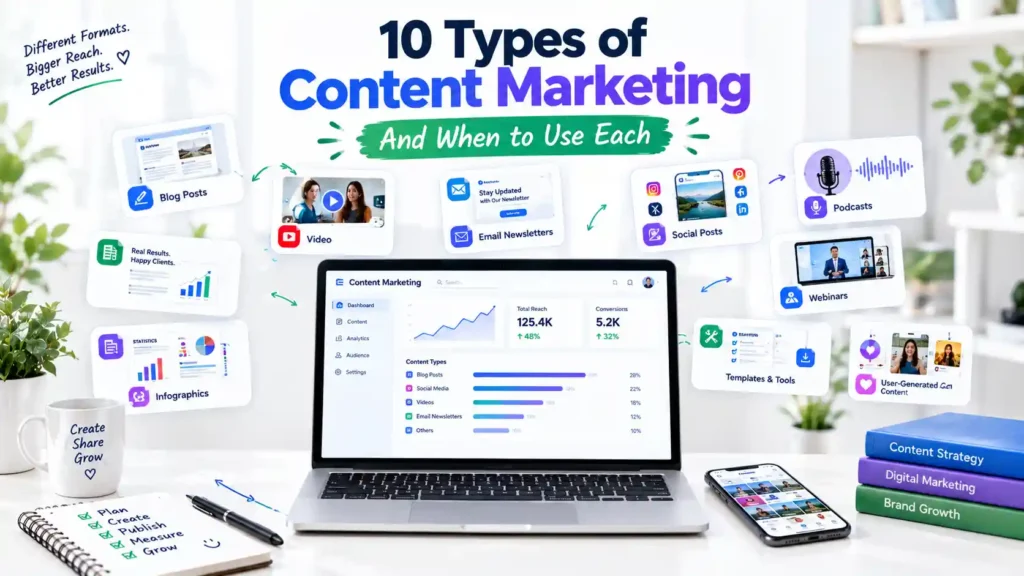

Content marketing can take many forms, from blog posts and videos to email newsletters, podcasts, webinars, and free tools. The challenge isn’t choosing every format at once. It’s choosing the formats your audience actually wants to consume and your team can consistently produce.
Below, we’ll look at 10 common types of content marketing, what each format is best suited for, and when it makes sense to use it.
Quick Comparison
| Format | Best For | Effort |
|---|---|---|
| Blog posts | Search traffic, long-term compounding | Medium |
| Video | Trust, demos, social reach | High |
| Email newsletters | Owned audience, repeat attention | Low-Medium |
| Social posts | Reach, community, quick feedback | Low |
| Podcasts | Depth, loyalty, niche authority | High |
| Case studies | Proof for buyers late in the funnel | Medium |
| Infographics | Shareable data, backlinks | Medium |
| Webinars | Lead generation, B2B | High |
| Templates & tools | Practical value, repeat visits | Medium |
| User-generated content | Social proof, low production cost | Low |
Search-Driven Formats
1. Blog Posts
Blog posts can continue bringing organic search traffic long after they are published, especially when they target topics your audience actively searches for.
Those are the posts that answer the questions your audience is asking. Oftentimes, posts that target questions end up answering an internal work question that the product team has.
- Best for: traffic that requires little to no effort to maintain
- Worst for: persuading management to give you a raise

2. Templates and Free Tools

Calculators, checklists, and spreadsheets are resources that people find useful and return to. Links to resources like these are more common and easier to earn than links to a standard blog post.
- Good for: links and user retention
- Bad for: creating something users have no interest in
A content calendar template is a good example of this format in practice.
3. Infographics
Visual data is compelling and share-worthy. Expect social shares and backlinks to your site for data presented in this way.
- Best for: presenting stats
- Watch out for: creating designs before you have data

Video and Audio
4. Video Content
Helps build trust quicker because of face-to-face interaction.

This method uses video content to give a behind the scenes look at you or your brand. Lower production value content can be shared for free on social media. Higher quality video content can be costly.
- Benefits: trust building, demonstrating a product
- Drawbacks: quickly wasting money on production if idea is not tested first
Start with short, useful videos before investing heavily in production. A simple product walkthrough, tutorial, or behind-the-scenes video can tell you whether your audience responds to the topic before you spend more time and money on production.
5. Podcasts
Podcasts can build a loyal audience, although growth is often slower than with short-form social content.
You get long formats with podcasts. Long formats let you tackle ideas with depth and nuance. Podcasts are great for building authority with a specific audience.
- Good for depth, audience loyalty, professional reputation, positioning within your industry
- Expect slow rate of growth


6. Webinars
Webinars combine live education or product demonstrations with lead generation. Attendees register to show up and give their emails to attend.
- Be aware of: Low show rates, always create a video copy of the presentation.
- Ideal for: Need for B2B leads
Owned and Social Formats
7. Email Newsletters
You control who sees your emails. No algorithm can restrict access from your subscribers.
Developing and sticking to a consistent pattern for sending emails is better than sending long emails less often.
- Best for: control over audience, consistent readership
- Worst for: incentivizing and growing an email list without actually emailing it
How much are you willing to invest to grow your email list?

8. Social Media Posts
Get feedback quickly at the lowest cost. Great for quick and easy angle tests.
- Best for: Reach, Audience Building, Concept Testing
- Watch out for: short-lived trends and algorithm changes
9. User-Generated Content
Photographs, comments, and accolades posted by your customers are virtually free to produce and carry more weight than your own promotional messages.
- Best use: social validation
- Beware: using them without authorization
Proof-Focused Formats
10. Case Studies

Specific customer results are the most effective for conversion.
Results are easier to understand when they are specific and measurable. “Increased sales” is not as compelling as “40% increase in sales in a 6 month period.”
- Best for: conversion of customers in the purchasing stage
- Watch out for: Immeasurable results
How to Pick the Right Format
Work with existing audience preferences, not your own.
Your audience prefers finding solutions through blog posts and/or templates.
Your audience prefers consuming information through social media and/or videos.
Your audience prefers listening to information through podcasts.
Business-to-business (B2B) sales: case studies and/or webinars.
Start with two formats, and stick with them. Add a third after three months.
Common Mistakes
• Running six formats poorly instead of two formats well
– Posting only videos because that is what is popular to post, even when your audience does not consume your content in that format.
– Not turning a single podcast episode into written content, clip synopsis, or a newsletter.
– Being unable to differentiate between a format’s reach and format’s conversion.
FAQ
What are the main types of content marketing?
Most of what a marketing team creates is blog posts, videos, email newsletters, social media posts, podcasts, case studies, infographics, webinars, templates, and user-generated content.
Which type of content marketing is most effective?
There isn’t one content marketing format that works best for every business. The right choice depends on your audience, goals, resources, and the type of content you can consistently produce. Blogs, videos, email, social posts, and other formats can all work when they match the audience and objective.
The number of formats you should use is situation-dependent. Two or three formats are a good starting point.
Final Thoughts
It is more important for a creator to remain consistent with their content than for them to concern themselves with the format of that content. A creator would be better served by publishing subpar blog posts weekly than they would be by publishing a podcast with only four episodes released over a long span of time.
If possible, you should create the type of content that your audience is most receptive to. Beyond that, you should make the type of content that you are most able to create. Seeing as you’ll be creating the content over a long enough period of time to determine its effectiveness, you should be able to gauge whether your audience is as receptive to your content as you had hoped.