
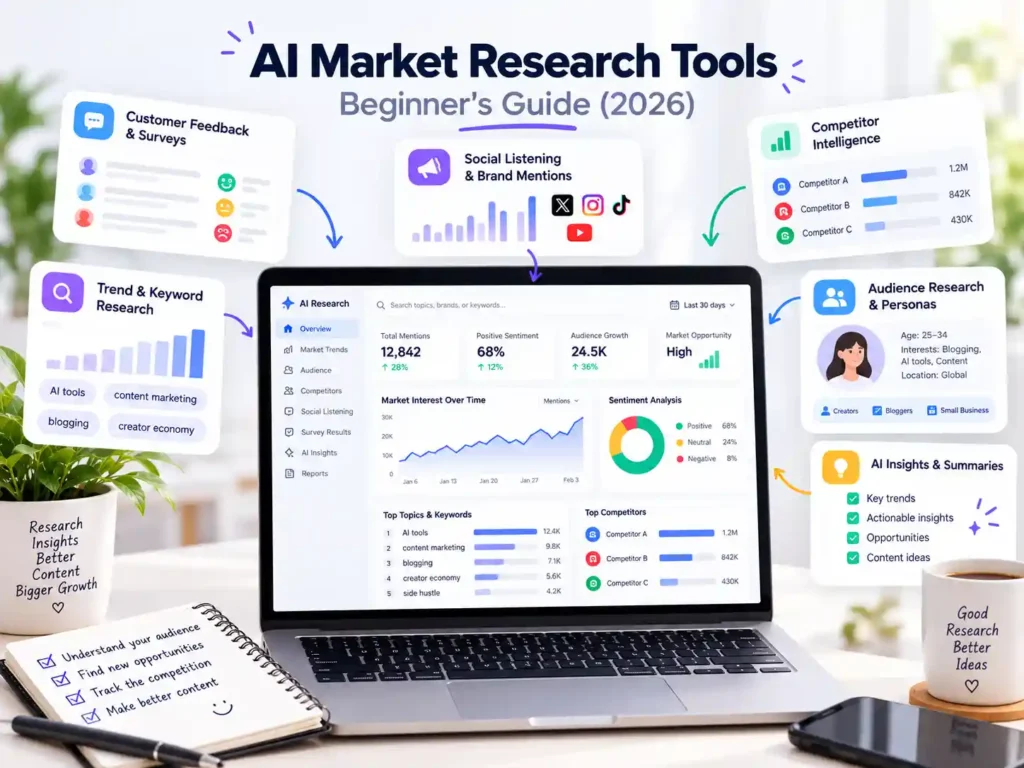

Market research can take a lot of time. Businesses may need to collect customer feedback, study competitors, monitor trends, analyze reviews, and sort through large amounts of data before they can make a decision.
AI market research tools can speed up many of these tasks. Depending on the platform, they can analyze customer feedback, monitor competitors, identify trends, research audiences, and turn large datasets into easier-to-understand insights.
This guide explains the main types of AI market research tools, what each category is useful for, how to choose one, and what you should check before trusting the results.
What Are AI Market Research Tools?
AI market research tools are software platforms that use technologies such as machine learning, natural language processing, automation, and generative AI to collect, analyze, and summarize market data.
Think of them as research assistants. They can process large amounts of feedback, identify patterns, group similar responses, detect sentiment, monitor trends, and summarize findings much faster than manual analysis.
However, AI doesn’t remove the need for human judgment. You still need to check the sources, understand the context, and decide what the findings actually mean for your business.
A typical AI-based market research workflow has three stages:
- Data collection: Gather information from sources such as surveys, reviews, social platforms, forums, websites, and search trends.
- Data analysis: Use AI to identify patterns, themes, sentiment, trends, and relationships in the data.
- Results presentation: Turn the findings into summaries, reports, dashboards, or other formats that are easier to understand.

| Tool | Best For | Research Type | Free Option |
|---|---|---|---|
| Qualtrics | Surveys & feedback | Quantitative | Yes |
| Brandwatch | Social listening | Consumer intelligence | No |
| Crayon | Competitor monitoring | Competitive intelligence | No |
| SparkToro | Audience research | Audience intelligence | Yes |
| Semrush | Search & competitor research | SEO/market intelligence | Yes |
Why Businesses Use AI Market Research Tools
The traditional method of market research still has merit, but it has its constraints. Below are the most common reasons more and more market researchers are adopting AI in market research.
Save Research Time
One survey report that once took a month to complete can now be done in a matter of hours. The rapidly changing market means that the first to answer and act on market changes have a competitive advantage.


Reduce Research Costs
While a human team may be able to gather and read 300-500 open-ended comments, AI software can process much larger volumes of text and feedback than a person can reasonably review manually, giving you a better broader view of customer sentiment.
Analyze More Data
While a human team may be able to gather and read 300-500 open-ended comments, AI software can process much larger volumes of text and feedback than a person can reasonably review manually, giving you a better broader view of customer sentiment.


Monitor Changes Over Time
Given the fast paced nature of the market, there are numerous phenomena that may arise and be short-lived. With constant automated tracking, you’ll be alerted of changes rather than learning about them months later.
Types of AI Market Research Tools You Should Know
The AI market research tools available on the market don’t all solve the same problem. Here are the main categories, so you can pick the right tool for your case.
1. AI Survey and Customer Feedback Analysis Tools
Surveys collect a large number of open-ended responses. It’s time consuming to manually sort and analyze that data. These platforms automatically group responses with similar meaning. They pick out sentiments like happy or angry, and show the main positives and negatives.
Some of these tools are Qualtrics (for text analytics), SurveyMonkey (for survey building and analysis using AI), and Thematic (for theme detection for feedback).


2. AI Social Listening Tools
Software that listens socially identifies your brand, product and industry mentions across social media, forums, and news sites. It shows what is said, how people feel, and the hot topics. Among the AI market research tools, this category is the best for reputation management.
Brand watch, Sprinklr and Brand24 are some of the tools that track brand mentions and sentiment on social media, news, and forums.
For creators and brands, these insights can also improve how AI is used for social media planning and content creation.
3. AI Competitor Intelligence Tools
They help you monitor competitor pricing, product launches, advertisements, website alterations, and content strategy. With these tools, you can find competitors’ successes and failures, as well as find untapped market potential. Well known tools: Crayon, Similar web, and Rushmore.


4. AI Trend and Keyword Research Tools
For content creators, these programs provide what people are searching for and the trends that are emerging. This helps produce content based on what the audience wants as opposed to what is guessed.
Some options include Google Trends (free), Republicanism (what questions do people have), Exploding Topics (up and coming trends), and Rushmore or Ahrefs (keyword options).
5. AI Customer Persona and Audience Research Tools
Certain tools integrate data from multiple sources to develop audiences based on interests, age, purchasing behavior, and pain points. Others make use of generative AI to simulate user responses to customer ideas to test ideas in an early stage. Well-known tools: Separator and Audience for audience research, Delve AI and Synthetic Users for AIs and simulated users respectively.
Note: Features, pricing, data sources, and usage limits can change over time. Check each tool’s official website before making a purchase.

Step-by-Step: How to Use AI Market Research Tools Effectively
Purchasing a tool is simple. Getting worthwhile findings takes a bit more work.
- You need to come up with a research question to guide your effort. A clear research question produces useful answers. For instance, “Why do customers make a single purchase and never return?”
- Next, you need data to work with. Import surveys, connect your socials, or Import survey responses, connect relevant data sources, or add competitors and topics you want to monitor.
- Let the tool analyze the data. Review sentiment analysis, topic clusters and trend lines.
- Verify the findings. Look through the samples of the raw data for yourself to identify where AI missed the mark.
- Make changes based on the findings. Alter your message or product and/or plan new content.
- Make this a habit and continue the cycle regularly.
Benefits for Bloggers and Small Businesses
While AI market research tools might not be free, they are a low-cost alternative to traditional market research. For a fraction of the cost, AI tools can help micro-influences and bloggers find what their audience is curious about. Small shop owners can find out what product features their customers appreciate the most. Freelancers can find out what their competition is charging.Bloggers can combine audience research with AI content tools to move from finding ideas to creating and publishing content faster.

Examples Include:
- Finding niche topics and questions your target audience is searching for.
- Evaluating what customers dislike about a competitor’s product.
- Testing different headlines, offers, or product descriptions.
- Determining how customer sentiment about your niche changes over time.
Limitations and Risks to Keep in Mind
The best AI market research tools are still not perfect. Here are some weaknesses to be aware of.
Bias in data: If the underlying data is biased, the conclusions can be biased too.
Lack of context: AI can miss sarcasm, local expressions, cultural references, or context that changes the meaning of feedback.
Over-reliance: It cannot replace gut feeling and face to face conversation with customers.
Privacy and legal issues: Personal information and other sensitive customer data require appropriate security and privacy safeguards.
Outdated or inaccurate data: Verify important data before acting on it.
Human judgment still matters: Treat AI as an assistant, not the final decision-maker.
Best Practices for Getting Accurate Results
- AI tools rely on data. Data can be reviewed and validated by human review.
- Relying on only one data source makes your business vulnerable to changes outside of your control. Use multiple.
- Asking pointed questions makes for a more robust answer. Broad questions and answers lead to missteps.
- Data is dirty and out of date. Document what you learn so your team can build on it.
- Test your conclusions with small experiments before large changes.
- Getting longer term value from AI market research tools requires adopting the habits above.
Frequently Asked Questions
Are AI market research tools accurate?
Usually accurate for finding trends in large sets of data, but reliance is subject to the quality of the data. Key insights should be checked manually.
Can beginners use AI market research tools?
Yes. Several platforms have dashboards and templates designed for non-technical users.
Are there free options?
Many providers give you the opportunity to try their service for free, whether it is a free trial period or a free plan with limitations.
Do these replace human researchers?
No, they help with the analysis, but people still need to provide interpretations and make decisions.
Market research becomes even more useful when the insights are connected to a complete generative AI content creation workflow.
Conclusion
- AI market research tools can make it easier to collect, analyze, and understand customer, competitor, and market data. But the right tool depends on the research question you’re trying to answer.
- Start with one clear goal, choose a tool that fits that goal, and verify important findings before acting on them. You don’t need a large collection of subscriptions to get started. A focused research process and reliable data are more valuable than having dozens of tools.
- As your business grows, you can add more specialized tools when you have a clear need for them.